Key Takeaways
- The Model Context Protocol (MCP) is an open protocol that allows AI agents to interact with business tools and data via a shared interface.
- MCP doesn’t secure itself: as per the specification, it is “not responsible for enforcing these security principles at the protocol level”.
- Before connecting MCP servers to company data, organisations need identity, least privilege access, audit logs and a register of approved servers.
MCP enterprise security has moved from a developer footnote to a governance question. The Model Context Protocol is becoming the standard method for AI agents to interact with the systems where the work takes place, and Gartner cautioned in April 2026 that “MCP’s design is focused on interoperability and developer velocity, not on enforcing security. The protocol can be as easy to link to your finance database as a weather application, and you can choose to let it see the data, affect that data, or simply log the fact that it saw the data, and that is up to your organisation.
What Is MCP?
The Model Context Protocol (MCP) is an open protocol for discovering, requesting and using external tools and data from the AI application via a single interface. It was introduced by Anthropic in November 2024 and donated to the Linux Foundation’s Agentic AI Foundation in December 2025, meaning no single vendor has control of it. The AI applications access MCP servers, which serve data, prompts and tools that the model can execute.
Prior to MCP, each AI model/Business system required a unique integration. For that reason, the documentation of the protocol likens it to a ‘USB-C port for AI’.This is because the protocol allows any compatible AI application to work with any MCP server.
Why MCP Matters for Enterprise AI Right Now
In December 2025, Anthropic transferred MCP to the Agentic AI Foundation, which records 10,000+ live public MCP servers and 97+ million monthly downloads of the MCP’s SDK (software development kit), supported by ChatGPT, Gemini, Microsoft Copilot, and Visual Studio Code.
The pull comes from AI agents. By the end of 2026, task-specific AI agents will be used in 40% of enterprise applications, from fewer than 5% in 2025, according to Gartner. Agents that act need a standard, repeatable approach to AI agent integration. MCP for business provides it: build an integration once, reuse it across every compatible agent, and switch AI models without rebuilding connections.
The MCP Enterprise Security Risks Nobody Talks About
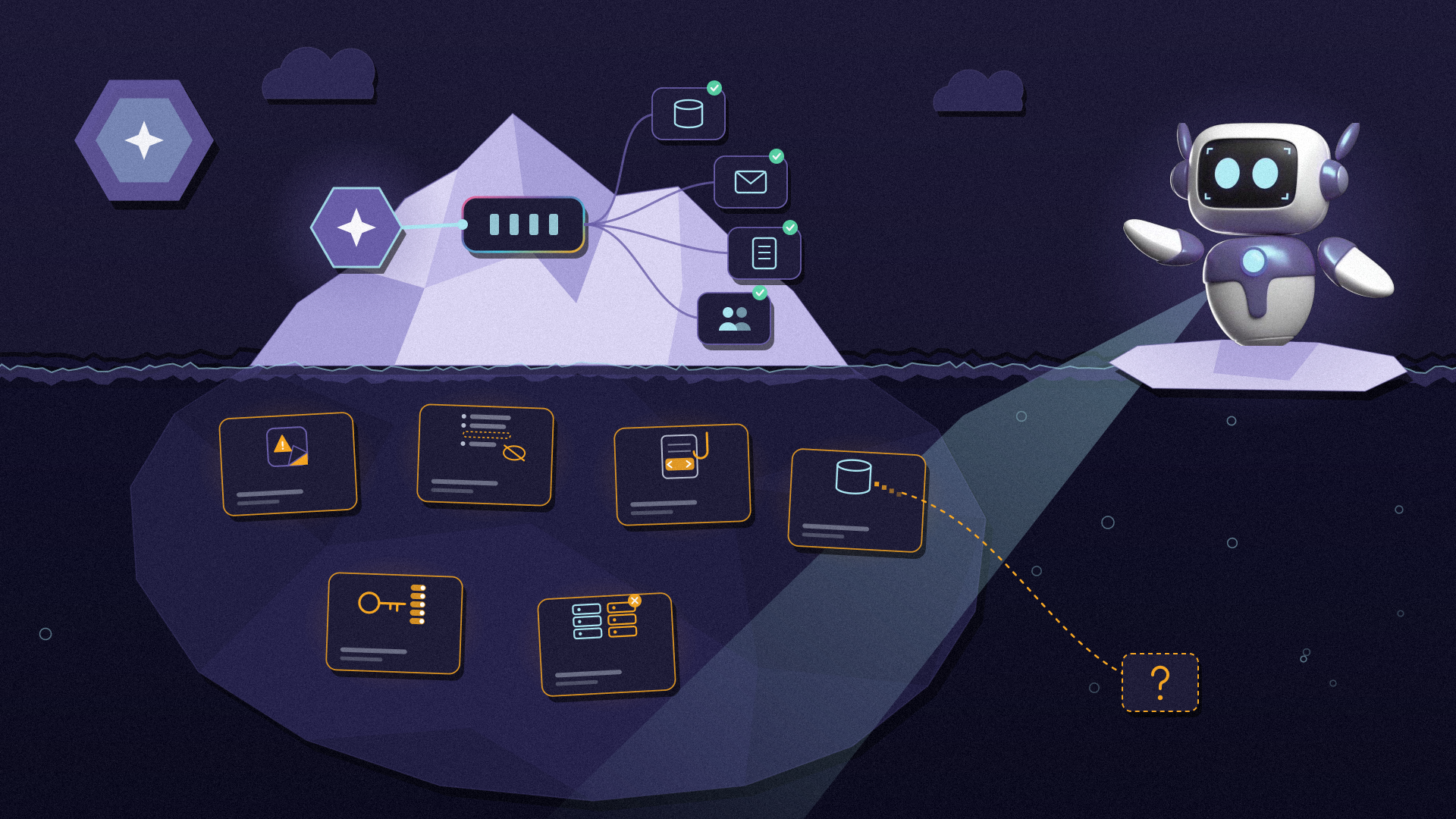
The specification is candid: tools “represent arbitrary code execution and must be treated with appropriate caution.” Independent research from the past year shows where the gaps are opening.
- Static, over-permissioned credentials
According to a report published in October 2025, Astrix found that 53% of the over 5,200 open-source MCP servers are using long-lived static secrets like API keys, and only 8.5% use OAuth. One shared service account gives every user the same broad access. Those keys also leak: GitGuardian’s State of Secrets Sprawl 2026 report found 24,008 unique secrets exposed in MCP configuration files.
A developer can stand up an MCP server in minutes, outside any security review. A July 2026 study (an arXiv preprint, not yet peer reviewed) audited 414 internet-facing MCP servers and found 91.8% lacked OAuth authentication. Across 640 confirmed servers, it counted 687 tool instances exposing shell execution without access controls. Unlisted connections cannot be governed.
- Tool poisoning and prompt injection
The specification warns that tool descriptions “should be considered untrusted, unless obtained from a trusted server.” An agent that reads an email or document containing hidden instructions may try to follow them with whatever tools MCP has given it.
In September 2025, Koi Security reported what it called the first malicious MCP server seen in the wild: a counterfeit “postmark-mcp” package on npm that, from version 1.0.16, silently copied every email sent through it to an external address.
Unlogged tool calls leave no answer to the auditor’s question: what did the AI do, for whom, and on whose authority? The Gartner report forecasts that by 2028, one in every four enterprise generative AI applications will have five or more minor security breaches in a year. Without the audit trail being done by AI, each of them is an investigation without evidence.
Checklist Before You Connect MCP to Company Data
Gartner advises authentication and authorisation “tailored specifically for AI agents, not inherited from human user roles.” Applying zero trust for AI agents means six controls:
- Use your identity provider: Agents become authenticated users or named agent identities via single sign-on (SSO), and OAuth take the place of static keys.
- Pass through user permissions: The agent only sees what the person asking could already see.
- Keep an approved-server register: Each MCP servers are checked, owned by a named team, and kept on a checked version.
- Separate read from write: Begin read-only; only add data-changing actions as approved by human intervention.
- Log every call: Record the user, tool, input, output, sources used.
- Run it in your own environment: Store models, indexes and connectors within your own cloud tenant.
Governance Underneath the Protocol
MCP standardises the connection, but it is not what an agent can see or do. That is the layer VaultiScan is built for. Vaultiscan is built around those controls. The answers to the questions given by Vaulti GPT and Vaulti Lake are only generated from data that the user is authorised to access, with each answer being traceable to its source. The platform is hosted on Microsoft Azure within the customer’s environment and the customer data is not used for model training. Vaulti Act, Vaultiscan’s agentic automation layer, provides workflows that include human approval steps so that an agent can pre-pare an action while a person signs it off. Vaulti SDK brings the same governed retrieval into a company’s own applications.
Frequently Asked Questions
- Is MCP safe for enterprise use?
Yes, if it has proper identity, permissions and logging. MCP is a connection standard, not a security product, which implies that the controls around each server decide how safe it is.
- How to secure AI data when the agents connect through MCP?
Start read-only, pass through existing user permissions, replace static API keys with OAuth, register every server, and log every tool call.
- Who should own MCP governance?
Gartner suggests domain-oriented ownership, where the teams who own the data own the MCP servers and set the guardrails, with IT security providing shared standards.
Connect Fast, Govern First
MCP provides one consistent approach for AI agents to access systems where work is conducted. It’s designed to be interoperable, though—because as evidenced by 2025 and 2026, when governance takes over, static keys, unregistered servers, poisoned packages, untraceable actions. The organisations that benefit the most will treat each MCP server as a production server and will implement all the security measures that will come with AI security best practices from the start: verified identity, inherited permissions, human approval of writes, and a history of all calls.
Want to see governed AI agents working on your own documents and data, with every answer cited? Talk to the VaultiScan team.