Key Takeaways
- Most website chatbots leak leads, not close them. Only 27% of customers would try one again after a bad experience, and just 7% used one in their last service interaction.
- Investment keeps climbing anyway. AI spending among service leaders is up 38% while overall budgets rose just 2%, and GenAI chatbots are tipped to become the top service channel within two years.
- A sales-ready lead is structured, not a transcript. It matches user with question and requirement – allowing a rep to act without re-reading a conversation.
A potential purchaser starts talking with the widget on a vendor’s price page and asks two questions: Does it support single sign-on and how much does it cost a mid-size deployment? The bot responds with a non-specific message to the first question and to the second by simply not answering it. The visitor closes the tab. Nobody on the sales team ever learns they were there, what they asked, or that they were ready to talk numbers.
(This example highlights the issue and does not describe a reported deployment.)
It is this disconnect – the visitor’s actual inquiry versus the salesperson that never hears it – that is where most website chatbots fall short. A generic AI customer service agent responds from a pre-designed response and that’s it—they are not designed to be aware of a buying signal, let alone pass it on to sales. Vaultiscan fills in the middle, by basing all of the chats on a business’s own product and pricing data and recognising the qualified exchange as a structured lead that can be used to support HubSpot’s CRM, Salesforce’s CRM, or any other CRM workflow the business is using.
Why Most Website Chatbots Don’t Generate Real Pipeline
Gartner’s most recent customer survey, 3,566 B2B and B2C respondents polled in February and March 2026, found that only 27% of customers would try a chatbot again after a bad experience, and just 7% had used one in their most recent service interaction at all. 87% said access to a human agent is essential whenever a business puts GenAI in front of customers, and respondents were roughly three times more likely to turn to a third-party GenAI tool than the company’s own bot.
None of that is a reason to pull chat off the site. Investment keeps climbing regardless: a separate Gartner survey of 199 customer service and support leaders found AI spending up 38% in 2026 while overall department budgets grew just 2%, and respondents expect GenAI chatbots to overtake live chat as the most valuable service channel within two years. The chatbot itself is not the problem. What it can see, and what happens to the conversation afterwards, usually is.
What Counts as a “Sales-Ready” Lead
A sales-ready lead is a captured conversation that arrives with enough identity, intent, and context for a rep to act on it immediately, not a transcript someone has to read, interpret, and re-enter by hand.
The category is not standing still, either. The global chatbot market is on track to grow from $1.70 billion in 2026 to $7.96 billion by 2035, and large language models are already the fastest-growing engine behind it: chatbots and virtual assistants account for more than a quarter of all LLM application revenue in 2025. The question for a sales team is no longer whether to run a chatbot.
A sales-ready lead is a captured conversation that is sufficiently identified, in-scope and with enough intent for a salesperson to take immediate action on without having to re-enter, read, and interpret a transcript. It’s not just that the category isn’t still, it’s that it’s growing.
The global chatbot market is projected to increase from $1.70 billion in 2026 to $7.96 billion by 2035, with large language models being the fastest-growing engine behind this growth: chatbots and virtual assistants make up more than a quarter of all LLM application revenue in 2025. So, the question for a sales team now isn’t who should or should not use a chatbot. It is whether the one running captures a lead, or just a transcript.
How Vaultiscan Turns a Website Conversation Into a CRM-Ready Lead
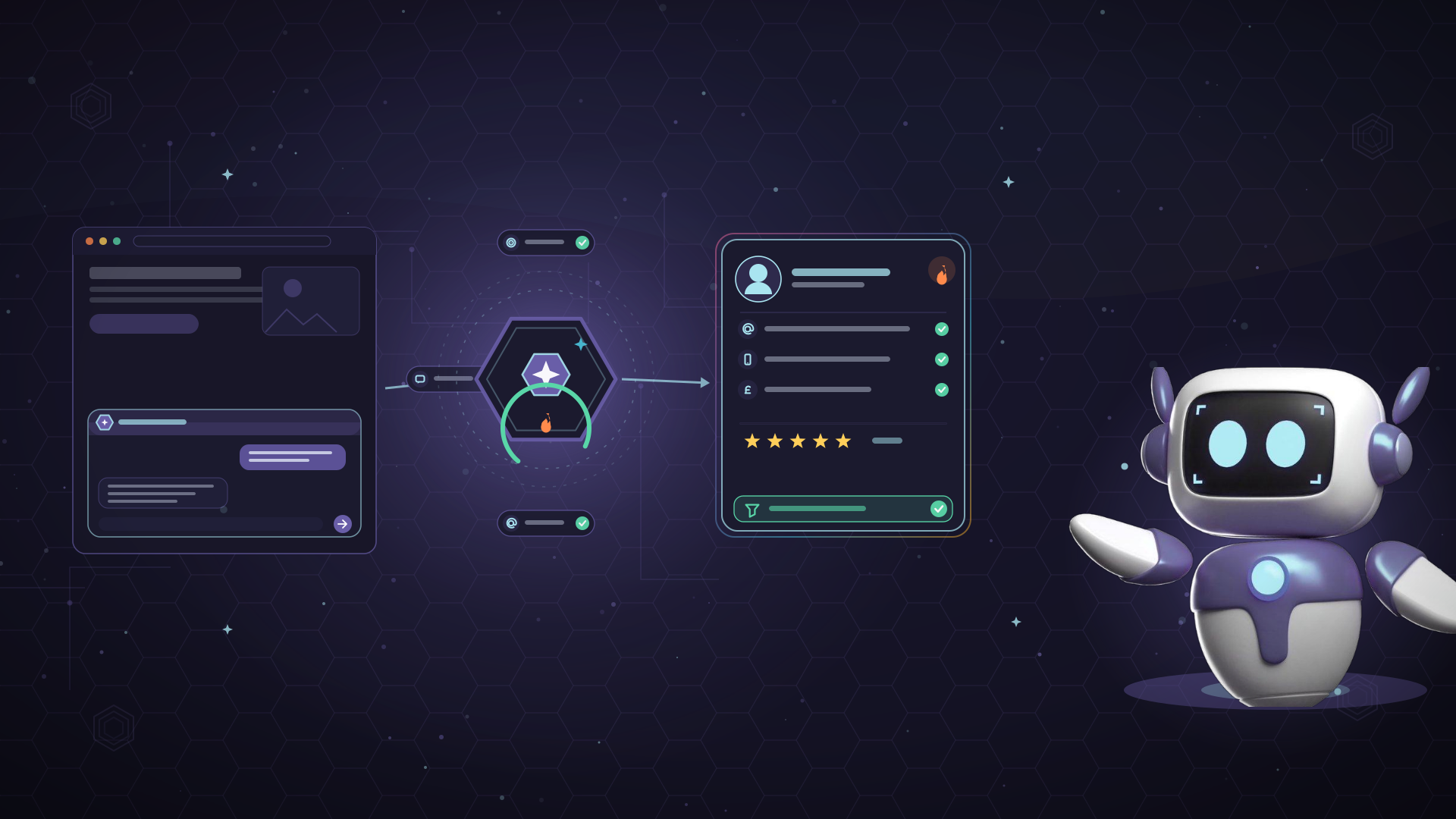
When a visitor asks about SSO or deployment cost, they receive a real, source backed answer from Vaulti GPT, rather than a deflection in the form of a generic script, as Vaulti GPT provides every answer and response based on the business’s own content. The conversation, in turn, brings up the buying trigger: what was asked, what the visitor is particularly interested in (security, price, time), and any name given, company, e-mail address.
Embedded directly in the website’s own chat experience, not as a separate widget, Vaulti SDK, which exchange into a lead record, consist of identity fields, the questions asked, the intent signal, and a link back to the full conversation. Its job is to embed AI in app experiences a company already runs, in this case its own public website, rather than stand up a separate tool.
Vaulti SDK turns the website conversation into a structured hot lead, capturing relevant identity, intent and conversation context. The lead can then support the business’s existing CRM workflow—whether the organisation uses HubSpot, Salesforce or another platform.
The difference is easiest to see side by side.
| Comparison Point |
Traditional Website Chatbot |
Vaultiscan-Embedded Chat |
| Answer source |
Fixed script or generic FAQ |
Grounded in the business’s own product, pricing, and policy content |
| What the rep receives |
A raw transcript, if anything |
A structured lead record: identity, intent, and context |
| Where it lands |
Stays inside the chat tool |
Built to support the CRM workflow already in place: HubSpot, Salesforce, or another platform |
| Follow-up starting point |
Rep re-reads the whole conversation |
Rep works a lead that already states who the visitor is and what they need |
Related reading: AI Knowledge Management Software: Benefits & Use Cases
Frequently Asked Questions
- What makes a lead “sales-ready” instead of just a chat transcript?
It comes with identity, intent, and context – what was asked, what the visitor needs, without having to read a whole conversation first – for a rep to act without having to re-read a whole conversation first.
- Does Vaultiscan automatically push leads into HubSpot or Salesforce?
No, and it’s not positioned that way. Vaultiscan connects to a business’s existing systems, CRM data included, using the same AI chatbot API approach it uses to ground its answers elsewhere, and Vaulti SDK embeds into applications a company already runs, its own website among them. What it produces is a structured, sales-ready lead: identity, intent, and context, built to support whatever CRM workflow the business already has, rather than a feature that syncs or pushes records into HubSpot or Salesforce on its own. Talk to Vaultiscan about how that fits the systems already in place.
- Is this the same as an AI chatbot for customer service?
Related, but scoped differently. An AI chatbot for customer service answers existing customers’ support questions. This is scoped to a website’s visitor traffic specifically, turning a prospect’s conversation into a structured lead rather than closing a support ticket.
- Does this replace the CRM or the sales team?
No. It does not replace either one. It closes the gap between a website visitor asking a real question and a rep finding out about it.
The Conversation Is the Pipeline
Most conversations about website chat start with the widget: how it looks, how natural it sounds, how quickly it replies. Widget quality was never why a chatbot failed to produce a lead. What matters is what it is allowed to know and whether the conversation ends as something a rep can use. A bot answering from a fixed script, with no structured way back to the CRM, wastes the visitor who was ready to talk.
With the answer supported by the business’s own content, Vaultiscan transforms the qualified conversation into a structured lead that can be used to further a pre-existing CRM workflow—rather than waiting for someone to ask a real question or for a rep to review the chat log. This is what sets apart an AI sales agent from a slightly interactive FAQ page.
Talk to Vaultiscan about turning website conversations into CRM-ready leads.