Key Takeaways
- An enterprise AI search platform provides answers from your own systems via semantic search and retrieval-augmented generation, with citations and permissioning on each query.
- AI platform and model spending is expected to grow 63.4% from $39 billion in 2025 to $64 billion in 2026, but budgets are now based on results, not pilots, according to Gartner.
- According to McKinsey, 88% of organisations are making regular use of AI, and most report that less than 5% of their EBIT is attributable to AI.
- The decisive evaluation criterion is permission fidelity at query time. An index that ignores source-system permissions turns search into a data exposure.
An enterprise AI search platform is a governed layer between your employees and every system your business runs on. It retrieves answers from your own documents, data and applications, produces answers in natural language, cites the source, and applies the permissions of the requester to each query. It introduces semantic search for keywords and provides answers based on your actual content, rather than a guesswork approach with a generic chatbot.
Buying one in 2026 is no longer an experiment. Gartner predicts global investment in AI platforms and models will hit $64 billion this year, growing by 63.4% from $39 billion in 2025. The same forecast carries a warning that shapes every evaluation now underway. As Gartner Sr Principal Research Analyst put it, “Enterprise AI budgets are coming under greater scrutiny, with increased focus on usage efficiency, cost control and measurable outcomes.”
That scrutiny is earned. McKinsey’s State of AI survey, conducted during mid-2025 and published in November, revealed that 88% of organisations use AI on a regular basis for at least one function, but most respondents said that less than 5% of their enterprise’s EBIT was due to AI. Adoption rates are almost universal. Value is not. The gap is invariably in the same place: the AI is not able to access—or it isn’t allowed to access the knowledge that would have made its responses useful.
This guide explains what these platforms are, how teams are using them, and the six criteria that most evaluations are based on, plus the governance requirement vendors often gloss over.
What Is an Enterprise AI Search Platform?
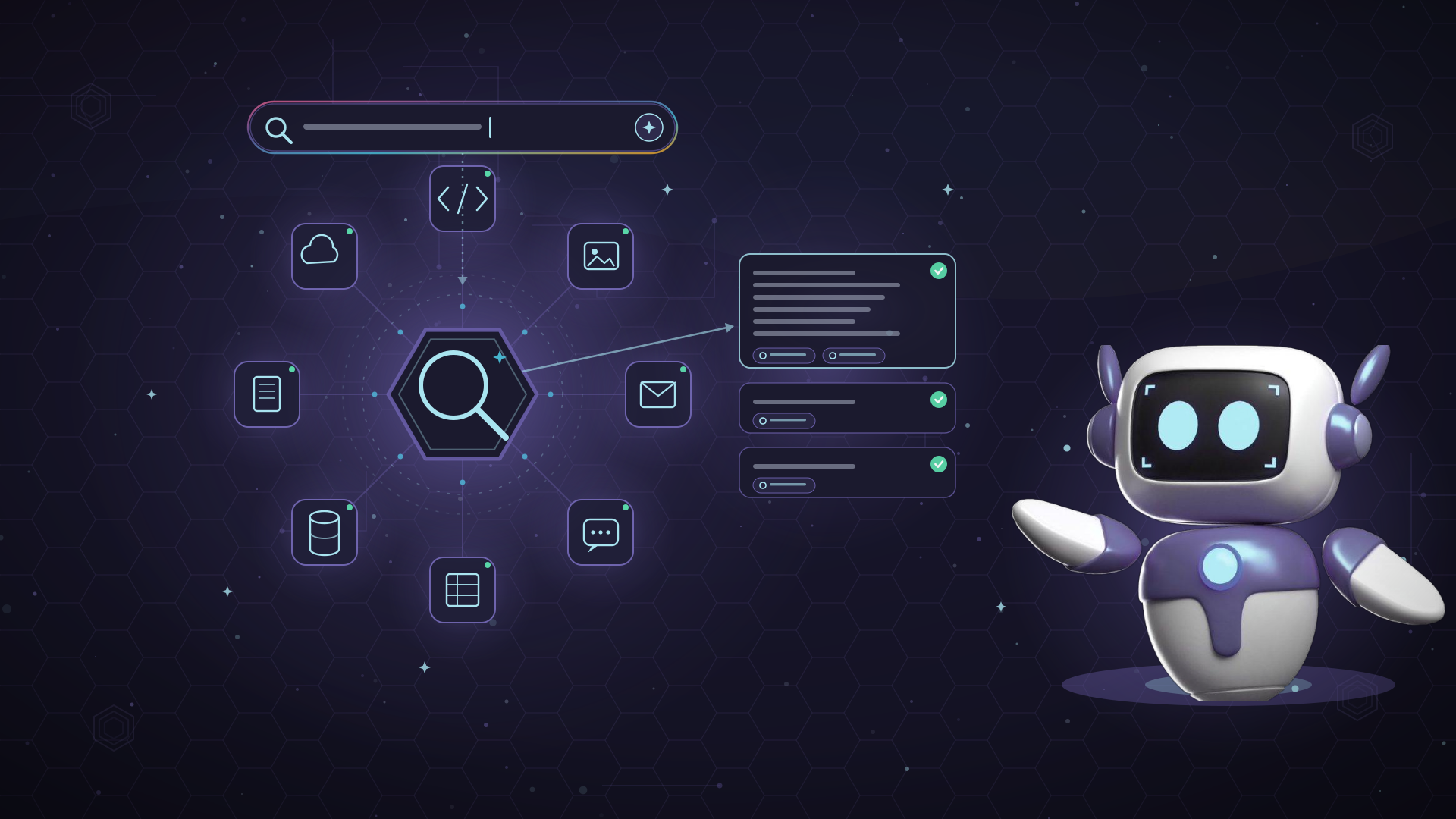
An enterprise AI search platform consolidates content from all over an organisation’s information systems, semantically indexes it and enables employees and AI agents to ask it of the system in natural language. Three capabilities separate it from a search box.
Semantic retrieval
Traditional search matches strings. Enterprise semantic search matches by meaning instead. So, a question like “what did we agree with the supplier on late delivery?” will return the relevant part of the agreement even if that part of the contract doesn’t contain those exact words.
Retrieval-augmented generation
An enterprise RAG platform queries your live knowledge base when the question happens and then writes an answer based on what it found. This is the mechanism that makes AI document search conversational instead of a list of links.
Permission-aware access
Retrieval is scoped to what the requester is cleared to see, checked on every request rather than once at login.
Traditional Enterprise Search vs Enterprise AI Search
| |
Traditional enterprise search |
Enterprise AI search platform |
| Query style |
Keywords and boolean operators |
Natural language questions |
| Matching |
String and metadata matching |
Meaning and intent, via embeddings |
| Output |
Ranked list of documents |
Written answer with linked citations |
| Scope |
Usually one system or index |
Unified across connected systems |
| Permissions |
Often a flat index, checked at login |
Enforced per query, per user or agent |
| Freshness |
Periodic crawl |
Continuous sync with deletion and permission propagation |
| Who it serves |
Human searchers |
Humans and enterprise AI agents |
Why Traditional Enterprise Search Stopped Working
This failure mode is not new to anyone who has had to operate an intranet. Content resides on SharePoint, CRMs, ERPs, ticketing systems, wikis, and shared drives, all of which have their own index, and their own understanding of relevance. Employees learn which system to check for which question, then stop looking when the answer is not in the first place they try. Coveo’s Workplace Relevance Report 2023 found 88% of employees feel demoralised when they cannot find the information they need to do their work, with 21% of millennials more likely to quit over obstacles that leave them feeling unqualified.
A general-purpose AI assistant does not fix this. It produces fluent answers with no connection to your systems, no citation to a source document, and no awareness of who is allowed to see what. That is a different problem, not a smaller one.
What Teams Actually Use It For
Deployments almost never start enterprise-wide. They start in one function where the cost of not finding something is easy to price.
Retrieving precedent clauses, obligations and prior negotiated positions across a contract archive, with the source agreement and version attached to every answer.
Answering policy questions against the current controlled document rather than a superseded PDF, with an audit trail of what was consulted.
Giving agents a cited answer from product documentation and past resolutions during the call, not after it.
Querying structured and unstructured content together, so a number in a report can be traced back to the document that produced it.
- Engineering and onboarding
Surfacing internal design decisions and their reasoning, so new hires stop rediscovering conclusions the organisation already reached.
Six Criteria for Evaluating an Enterprise AI Search Platform
Commercial evaluations in 2026 turn on the same six questions. Ask for a live demo against your own content on each one, not a slide.
- Permission fidelity at query time:Does the platform inherit and enforce source-system permissions on every retrieval, or does it build a flat index anyone can search? Thisis the most common architectural shortcut and the hardest to retrofit. In Vaultiscan, Vaulti Lake enforces access scope at the data layer, so retrieval is filtered before generation rather than after it.
- Citation on every answer:A generated answer without a link to the source document, version and owner cannot be audited and cannot support a regulated decision.Vaulti GPT answers only from governed content and attaches source, version and ownership to each response.
- Deployment control:If the content being indexed includes client records,contracts or IP, whether the platform can run inside your own environment stops being a preference. A private AI platform keeps enterprise data within your boundary; a multi-tenant index does not. Vaultiscan deploys into your environment or sovereign cloud, which is what makes it viable to index the material that actually matters.
- Connector coverage and freshness:Ask how often each connector re-syncs and how deletions and permission changes propagate. Stale indexes present retired policies as current guidance.Vaulti Lake continuously ingests and versions content from SharePoint, CRMs, ERPs and internal wikis.
- Agentic capability:Search is the first step. Enterprise AI agents that act on what they retrieve, drafting,routing or updating a record, produce most of the measurable return. Confirm the same permission model governs those actions. Vaulti SDK lets teams embed the same permissioned retrieval and audit behaviour into their own applications, so governance is inherited rather than rebuilt per project.
- Cost transparency:Gartner notes spending is shifting toward vendors that embed evaluation, costtransparency and usage tracking. Usage-based pricing on a system every employee touches daily needs a ceiling you can model in advance.
The Governance Requirement Most Platforms Understate
Once an AI search layer becomes agentic, it stops being a read-only convenience and becomes a non-human identity with standing access to your most sensitive content. Most organisations are not ready for that.
Okta’s Businesses at Work 2026 report found 78% of organisations name controlling non-human identity access and permissions a top concern regarding AI agent adoption, and 58% cite AI governance and identity management. Only 10% have a strategy for governing non-human identities at all.
The security economics point the same way. IBM’s Cost of a Data Breach Report 2026 found that the average cost of a global data breach has hit a new high this year at $4.99 million, up 12% from last year, and that AI-powered breaches, like deepfake impersonation and AI-powered malware, have increased by 56%.
An AI search engine for business that indexes everything without inheriting permissions is not a productivity tool. It is a well-organised data exposure waiting for one over-broad query.
How to Measure Return
Four metrics survive a budget review. Resolution time on the workflows you targeted, measured before and after. Deflection rate, meaning questions answered without escalating to a colleague or a ticket. Answer acceptance, the share of responses users act on rather than reformulate. Audit readiness, the time it takes to produce the source trail for a given decision. Baseline all four in the pilot function before rollout, or the second-year renewal conversation becomes an argument about anecdotes.
Frequently Asked Questions
What is the difference between enterprise search and enterprise AI search platform?
Traditional enterprise search provides a ranked list of documents that contain keywords. An enterprise AI search system is able to semantically retrieve content and produce a direct, cited answer from it, which is limited to the permissions of the requester.
Is an enterprise AI search platform the same as a RAG system?
RAG is the core retrieval mechanism. A platform adds the connectors, permission enforcement, versioning, audit logging and administration that make RAG safe to run across a whole organisation.
Can it run without sending company data to a public model?
Yes. A secure AI platform can be deployed in your own environment or sovereign cloud, so documents are indexed and queried without leaving your boundary.
How is ROI measured on enterprise AI search?
Through resolution time on targeted workflows, deflection of questions that previously became tickets, the share of answers users accept without reformulating, and reduced time to assemble an audit trail. Baseline each metric before the pilot.
How long does implementation usually take?
Most enterprises start with two or three high-value content sources and one department, then expand. Scoping connectors and mapping permissions is typically the longest step, not model configuration.
Retrieval Is the Real Differentiator
The model layer is commoditising fast. The difference between an AI deployment that fundamentally transforms a business and one that simply fails to get off the ground is being able to access the appropriate internal knowledge, point to the source of an answer, and deny requests it isn’t authorised to fulfil. Semantic retrieval without permission fidelity is a liability. Permission fidelity
without semantic retrieval is an intranet. An enterprise AI search platform has to deliver both, inside your own infrastructure, with an audit trail your compliance team can defend. See how Vaultiscan governs enterprise knowledge retrieval- Book a demo.