Key Takeaways
- While AI is already prevalent in the financial industry, compliance is still lagging. In ACA Group’s 2026 survey, 84% of firms use AI across their organisations, yet average AI use across compliance sub-functions is below 20%.
- The bottleneck is scattered knowledge, not a shortage of tools. Compliance leaders surveyed for the MCO Global Compliance Outlook run an average of 13.8 compliance systems.
- The safest first step is cited answers to internal questions. Compared to automated decisions on customers, which are considered to be high-risk for credit scoring by the EU AI Act from 2 December 2027, finding the existing policy and the source is less risky.
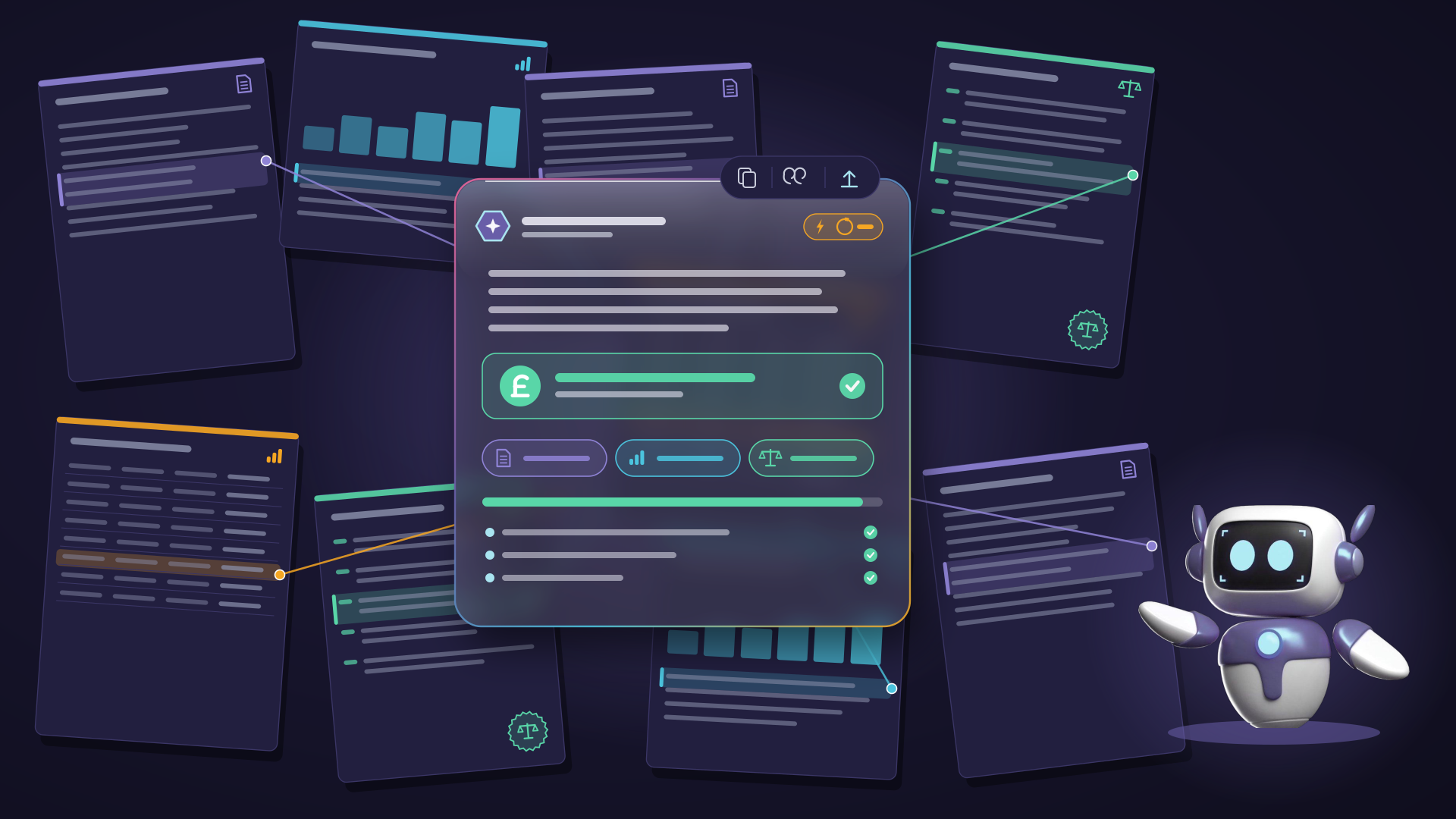
AI for financial services knowledge management gives employees one place to ask a question and receive an answer based on safe policies and regulatory guidance, reports, and data with a reference to the exact source. It saves the time of looking for a document that can potentially create a delay before judgment begins. It’s not about the use of Artificial Intelligence, it’s about what you do with it.
According to the survey carried out by the Bank of England and the Financial Conduct Authority (FCA) on financial services companies, 75% of firms surveyed are already using AI, and another 10% are anticipated to implement it over the next three years.
The void is “depth” and VaultiScan is the answer to filling it, to safely bring together documents, databases, and business systems within a secure layer on Microsoft Azure.
The Problem AI for Financial Services Knowledge Management Solves
1. Financial services firms do not lack information
They don’t have a known path to it. A single question regarding a fee waiver can impact a credit policy, product terms, a procedure manual, a regulator’s guidance note and last quarter’s risk report, all contained in different systems. The 2026 Global Compliance Outlook released by MCO indicates that, on average, compliance teams employ 13.8 compliance systems.
2. More tools have not closed the gap on their own
While many companies are already utilizing AI in some form, few are integrating it with the content their teams use on a daily basis. An assistant who is used for general purposes will be capable of writing and summarising but will lack access to the policy library, risk register or reporting database until they are linked, indexed and controlled. That’s why Wolters Kluwer’s banking compliance survey 2026 finds that while data quality and legacy system integrations are the bigger problems for financial institutions with AI than the regulation itself, data quality is the top challenge.
3. The cost is not only time
If there is no current policy in place, people will take action based on the previous policy. But AI does not correct this automatically: if the AI is directed to a library where outdated procedures are kept along with newer ones, the AI will confidently refer to outdated procedures. That’s why AI for policy documents is best when content owners have phased out old versions.
Where AI for Compliance Teams, Operations, and Risk Delivers First
Regulatory change is the clearest win. A regulator’s release of new guidance starts with figuring out what policies, procedures and controls are impacted. The AI does this cross-referencing and turns it into a search: Ask which policies contain the affected requirement and review the cited passages side by side. The team will also have a history of which and why, as it is all tied to the same clause. This is significant in the UK, where the FCA has confirmed it will continue to use its existing principles-based framework, and not new rules for AI, meaning that firms are assessed based on evidence and accountability.
Front-line staff and operations personnel require quick, accurate answers regarding products, fees and procedures. That’s how this is done under the hood: Only retrieval is done with the approved document set. The system determines which passages are most relevant, and returns a link to the relevant passages, as well as pulling out model answers from the passages alone. If the procedure doesn’t address the question, it’s not correct to write something like “I couldn’t find that,” rather than a bold guess.
Risk and finance reporting merges both the halves of the problem. Financial document search includes the narrative – Board papers, Audit results, Prior risk commentary. However, AI for financial reporting requires the numbers too, and these are stored in databases and reporting systems. Plain-English querying allows a manager to say, “show me complaints this quarter, by product” and get the resulting table without having to write SQL (Structured Query Language).
How VaultiScan Handles One Regulatory Update, End to End
Let’s consider the one regulatory modification in a VaultiScan-supported finance firm. A compliance analyst at a medium-sized lender discusses new regulations about vulnerable customers with Vaulti GPT and inquires about its internal policies and procedures that mention the word. The answer states the text(s) that are being referred to and the document that references them, that is, the analyst is reading the actual text, not a summary.
After the procedures are updated, a branch operations manager asks a question about the application of the new procedure to a particular product and receives a response from the new approved version. The risk analyst then asks, in natural language, the number of cases that the old process identified in the past quarter and enters the number into the board report in Vaulti Lake.
(This is an illustrative scenario)
The same controls apply throughout. VaultiScan is hosted on Azure-secured infrastructure. Teams have permissions to the information they can access, and external models are never trained on customer data. It’s the real-life example of secure AI for financial services: quick responses which an auditor can follow.
| Comparison Point |
Manual search across systems |
VaultiScan-assisted |
| Assessing a regulatory update |
Staff open policies one by one to find affected sections |
One question returns the affected passages; each linked to its source |
| Front-line product questions |
Check the intranet, then ask a colleague |
Answer drawn from the current approved procedure, with its source |
| Figures for a risk report |
Request a query from the data team and wait |
Ask Vaulti Lake in plain English |
| Evidence for audit and review |
Rebuilt from emails and shared drives |
Every answer traceable to the document or data behind it |
Related reading: AI Document Search Software: How It Transforms Enterprise Knowledge
Frequently Asked Questions
1. Can AI be trusted with regulated content?
Yes, as long as it includes citations and references to permissions that already exist and is only sourced from approved sources. When used like that, AI is merely an efficient research assistant, with humans remaining responsible for the final choice.
2. Is AI for regulatory compliance high-risk under the EU AI Act?
Usually not, for internal knowledge search. The high-risk list includes, among other things, the assessment of the credit worthiness of individuals, and with the Digital Omnibus those rules come into effect on 2 December 2027. Companies should continue to trace the integration of AI into every process and seek legal counsel.
3. Does our financial data leave our environment?
VaultiScan is deployed on Azure secured infrastructure with flexible deployment options, customer data never trains external models, and role-based permissions make it possible to control which teams have access to which information.
4. What is the best first use case for AI for banking teams?
Internal policy and procedure questions from operations staff. They are both high volume and low risk, easy to measure, and track the time taken to answer and the accuracy of the source cited, then broaden to data questions and other teams.
Financial Answers, Traced to the Source
AI is scaling up in financial services from pilot projects to regular business. The companies which are realizing a value first are not the ones with the most models, but the ones which made their policies, reports and regulatory guidance answerable, with a source behind every response.
Begin with one questions set with high volume, demonstrate accuracy, and then expand to data and new teams. That way, AI in banking operation becomes something compliance can sign off on, instead of chasing.
Talk to VaultiScan about cited answers across your policies, reports, and regulatory guidance.